


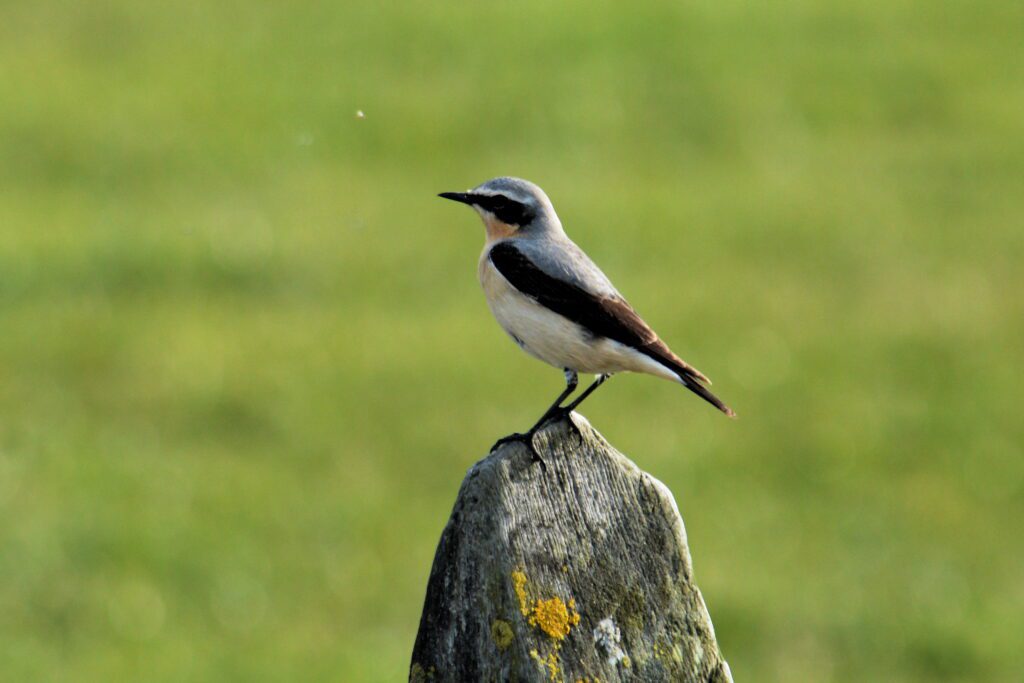
Wheatear
The wheatear (Oenanthe oenanthe) is a neat, upright bird of open stony ground. The spring male is blue-grey above with a black mask, black wings and a peachy breast; females are browner. In flight both show a bright white rump and a black ‘T’ on the tail.
On the islands
Wheatears nest in burrows, walls and rock crevices on machair, moorland and cliff tops, and are common on islands such as St Kilda, Fair Isle, the Hebrides and Shetland. Larger Greenland wheatears pass through the islands on their way to and from the Arctic.
When to see
One of the first migrants back, arriving from mid-March, and leaving by October.
Did you know?

Greenland wheatears make one of the longest sea crossings of any songbird, flying non-stop across the North Atlantic.
Where to see it on the islands
On Search Isle, the wheatear is recorded on 188 islands. They are spread across Scotland (115), England (35), Wales (17), Ireland (11) and Crown Dependencies (10).
The most records come from Calf of Man (Isle of Man, 1,863 records), Skokholm Island (Pembrokeshire, 1,535 records), St Mary’s (Isles of Scilly, 1,085 records) and Kitterland (Isle of Man, 1,071 records). These counts reflect where people have looked as well as where the animal lives: busy islands, and those with bird observatories, have far more records than remote ones.
Through the year
The wheatear is usually seen from April to September. You can listen to a recording of it beside this page.
Other songbirds
The wheatear is one of 9 songbirds on Search Isle, alongside Black Redstart, Blackbird, Blackcap, Blue Tit, Brambling, Bullfinch, Chaffinch and Chiffchaff.
