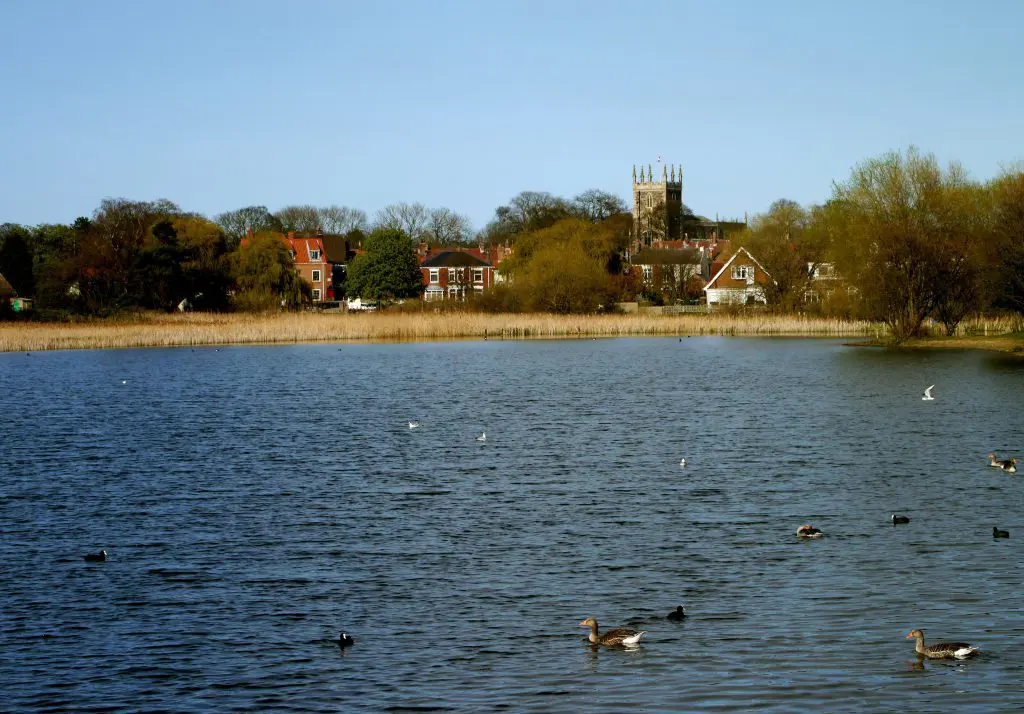

Hornsea Mere
1 island · England
Island Passport
How many of the 1 islands in Hornsea Mere can you collect?
0 of them collected by explorers so far
Hornsea Mere is the largest freshwater lake in Yorkshire, formed naturally at the end of the last Ice Age as glacial meltwater carved out a shallow basin near the East Yorkshire coast.
Covering around 300 acres beside the seaside town of Hornsea, it is significantly older than the many man-made reservoirs found elsewhere in the region, and its natural origins have given it an unusually rich, long-established ecology.
Wildlife
The mere and its wooded margins form a Site of Special Scientific Interest and RSPB reserve, supporting one of the largest concentrations of breeding and wintering wildfowl anywhere on the Yorkshire coast, including large numbers of greylag geese and a well-established heronry among the trees fringing its shore. Two small islands, Lady Island and Swan Island, sit within the mere, providing further undisturbed nesting habitat away from the boat traffic and lakeside path used by visitors.

More about Hornsea Mere
Managed jointly by the RSPB and the Hornsea Mere Estate, the mere draws birdwatchers throughout the year, while its position immediately behind the town’s seafront makes it an easy, well-known stop for visitors to this stretch of the Holderness coast. Boat trips run across the water in summer, and the mere’s mix of natural history and easy accessibility has made it one of the best-known inland wildlife sites in the East Riding of Yorkshire.
The Hornsea Mere Estate, which has owned and managed the mere and much of its surrounding land for generations, has long balanced its role as a private estate with public access for birdwatching, boating and walking, an arrangement that has helped keep the mere’s ecology largely intact even as the town of Hornsea itself has grown around it. The mere’s position just inland of Hornsea’s seafront means visitors can move between beach and freshwater wildlife habitats within a short walk, a combination unusual for the Yorkshire coast. The greylag geese that gather on the mere in large numbers each autumn have become one of its signature wildlife spectacles, drawing birdwatchers specifically for the noise and movement of the flock at dawn and dusk.
Landscape
Unlike the reservoirs found across much of lowland England, Hornsea Mere owes its existence entirely to natural glacial processes rather than to any dam or engineering project, making it a rare survival of a genuinely ancient lake landscape on the otherwise heavily eroded and constantly changing Holderness coast immediately to its east. That coastline is among the fastest-eroding in Europe, losing several metres of land most years, which makes the long-term stability of the mere immediately behind it all the more striking by comparison.
The biggest islands in Hornsea Mere
By area (acres)
- 1 Swan Island 2
