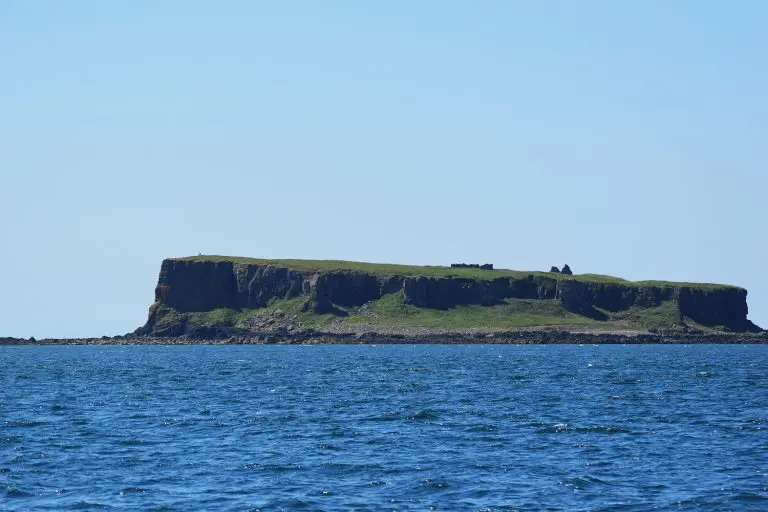
Lunga
Island Passport
Collect Lunga
Be the first to collect it
Tidal island. Stamps are never worth a risky crossing. Check official safe crossing times and local signs before walking out.
Lunga is the largest of the Treshnish Isles, the chain of volcanic islands off the west coast of Mull, and it is one of the best places in Britain to meet puffins face to face. It covers around 600 acres, and it has been described as “a green jewel in a peacock sea”. The Treshnish Isles lie within the Loch na Keal National Scenic Area.
Landscape
Like the rest of the Treshnish Isles, Lunga is of volcanic origin, with terraced slopes of old lava rising to a grassy summit, and steep cliffs and boulder beaches around its shores. Just off the island stands Harp Rock, a sea stack separated from Lunga by a narrow gut, which is packed with nesting seabirds in summer. In spring and early summer the island is bright with wildflowers, including primroses, orchids, sea campion, thrift, bird’s-foot trefoil, yellow flag and the rare oyster plant.
Island life
People lived on Lunga until the 19th century. The remains of their blackhouses can still be seen in the north-east of the island, where the village was finally abandoned in 1857. Since then the island has belonged to the birds and seals. Today, along with the rest of the Treshnish Isles, Lunga is in the care of the National Trust for Scotland, which took over from the Hebridean Trust in 2023.
The island is a Site of Special Scientific Interest, a Special Protection Area and a Special Area of Conservation, recognised for its seabird colonies and its grey seals.
More about Lunga
The island is a Site of Special Scientific Interest, a Special Protection Area and a Special Area of Conservation, recognised for its seabird colonies and its grey seals. Its puffins are the star attraction: thousands breed in burrows on the clifftops and are so used to visitors that they will often let you sit within a few feet of them.
Visiting

In summer, tourist boats land on Lunga from Ulva Ferry, Tobermory, Iona, Tiree and Ardnamurchan, usually combining a visit with Staffa. Visitors get a couple of hours ashore. Please keep to the paths and give nesting birds space. You can collect Lunga as a landing or a sighting in your Island Passport.
Wildlife and area
As well as its Puffin, Lunga is home to breeding guillemots, Razorbill, Shag, kittiwakes, Manx shearwaters and storm petrels. Barnacle geese spend the winter here, and Grey Seal gather on the rocks. Other islands nearby include Cairn na Burgh Mòr, Bac Mòr, Bac Beag and Staffa.
Tides
Now
—
Next high water
—
Next low water
—
Not for crossing. These are modelled tide heights, not safe crossing times. Tidal causeways and sands can flood quickly: always check the official safe crossing times and local signs before walking out.
Heights in metres relative to mean sea level; times are UK time. Not for navigation. Tide model: Open-Meteo (CC BY 4.0).
How to get to Lunga
You can reach Lunga on foot.
On foot
You can walk to Lunga at low tide. The way across floods quickly as the tide turns: check the safe crossing times and local signs, and never cross on a rising tide.
Plan your trip
Timetables change, so always check with the operator before you travel. We may earn a commission if you book through some of these links, at no extra cost to you.
Wildlife
69 species recorded on the island
Highlights


All wildlife
Loading all 69 species…
Nothing on the list is usually seen this month.
Recordings from Wikimedia Commons, under Creative Commons licences; hover a Listen button for the recordist. Sightings are records shared with GBIF since 2000.
Watching wildlife responsibly. Keep your distance from seals, seabird colonies and cetaceans, stay quiet, and never feed or chase wildlife. See the Scottish Marine Wildlife Watching Code.