North Ronaldsay
Island Passport
Collect North Ronaldsay
Be the first to collect it
This island is a protected nature reserve, so only sightings are stamped. Please do not land.
North Ronaldsay is the northernmost island in Orkney, lying around four kilometres beyond Sanday at the very edge of the archipelago. It covers 1,710 acres, making it the fourteenth-largest of Orkney’s islands, and its flat, exposed, low-lying terrain, fringed by two large sandy bays and a rockier western shore, offers little shelter from the North Sea and Atlantic weather that meet at this remote outpost.
The island’s population has fallen dramatically over the past two centuries, from 384 residents recorded in 1787 to just 59 by 2022, concentrated mainly around the settlement of Hollandstoun at the island’s southern end. Despite this decline, North Ronaldsay retains one of the most distinctive agricultural traditions anywhere in Britain: a drystone dyke, 1.8 metres high and encircling the entire island, was built specifically to keep the island’s unique native sheep breed confined to the shore, where they have adapted over generations to live almost entirely on a diet of seaweed rather than grass, a practice found nowhere else in the country.
History
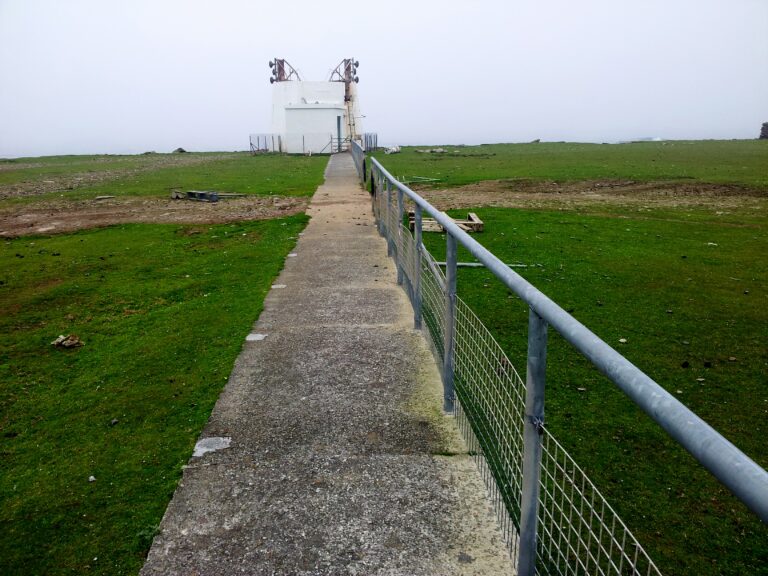
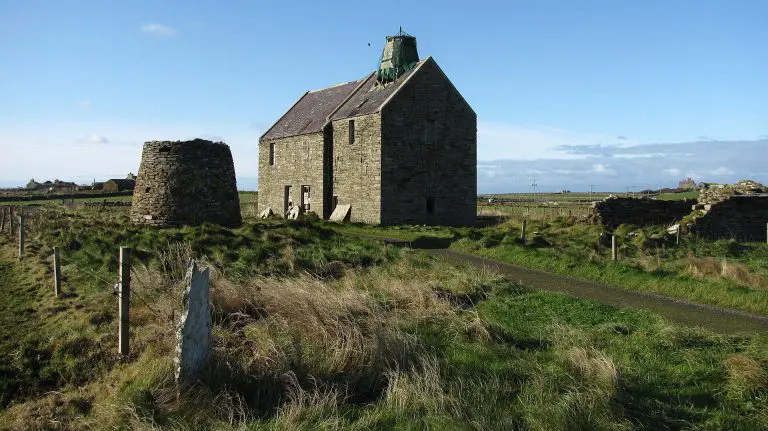
North Ronaldsay has been guiding shipping past its treacherous surrounding waters for well over two centuries. An early lighthouse, established in 1789, was extinguished in 1809 after proving inadequate, but still stands today as a historic landmark. It was replaced in 1852 by a new light at Point of Sinsoss, which at its full height is Britain’s tallest land-based lighthouse tower, a striking structure on such a flat, low-lying island.
Wildlife and area
Since 1987, North Ronaldsay has hosted a bird observatory that draws birdwatchers from across the country during the spring and autumn migration seasons, when the island’s isolated position makes it a magnet for rare and vagrant species blown off course over the North Sea. The surrounding waters support Grey Seal and Harbour Seal, along with Eurasian Otter, while its cliffs and shoreline attract Puffin, Common Guillemots and Razorbill typical of Orkney’s northern isles. North Ronaldsay lies within reach of other significant Orkney seabird and seal sites, including the sea stack of the Old Man of Hoy far to the south of the archipelago.
Tides
Now
—
Next high water
—
Next low water
—
Heights in metres relative to mean sea level; times are UK time. Not for navigation. Tide model: Open-Meteo (CC BY 4.0).
How to get to North Ronaldsay
You can reach North Ronaldsay by ferry and by air.
By ferry
Orkney Ferries sails from Kirkwall to North Ronaldsay, the longest crossing on the North Isles network.
By air
Loganair flies from Kirkwall to North Ronaldsay, the longest of Orkney’s inter-island air routes.
Plan your trip
Timetables change, so always check with the operator before you travel. We may earn a commission if you book through some of these links, at no extra cost to you.
Wildlife
156 species recorded on the island
Highlights


Island specials

All wildlife
Loading all 156 species…
Nothing on the list is usually seen this month.
Recordings from Wikimedia Commons, under Creative Commons licences; hover a Listen button for the recordist. Sightings are records shared with GBIF since 2000.
Watching wildlife responsibly. Keep your distance from seals, seabird colonies and cetaceans, stay quiet, and never feed or chase wildlife. See the Scottish Marine Wildlife Watching Code.