Barra
Barra is the southernmost large island of the Outer Hebrides, a compact, hilly island of white beaches, flower-filled machair and a medieval castle that stands on a rock in the middle of its harbour. It is about fourteen kilometres long and eleven wide, home to around 1,200 people, and joined by a causeway to little Vatersay to the south. Barra is famous for its airport, where scheduled planes land on a cockle beach between the tides, for its connection with the novel and film Whisky Galore, and for the warmth of its people. It has been described as the most Scottish place in Scotland, and Gaelic is still spoken by more than half the population.
Landscape

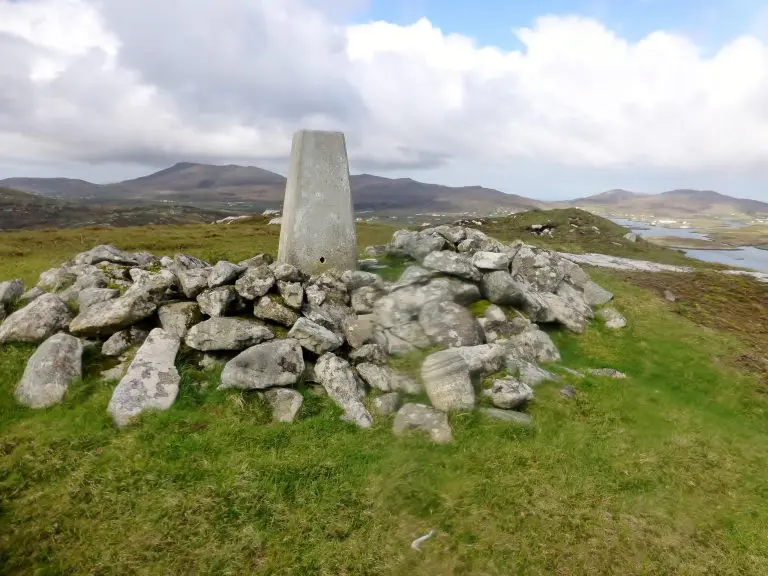
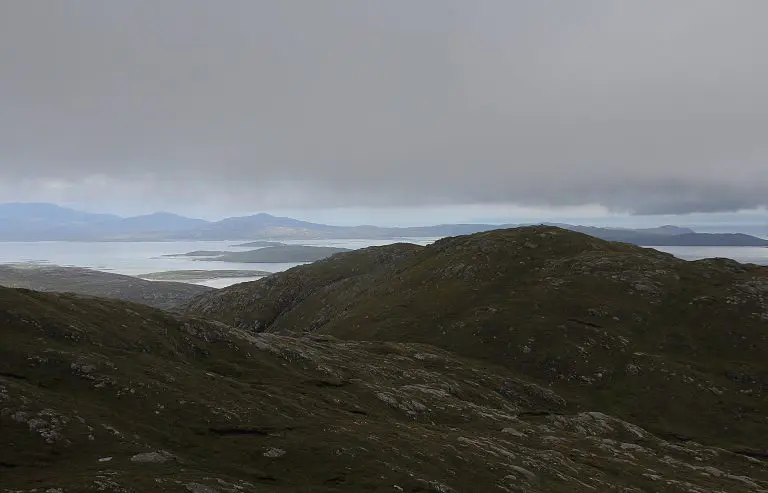
The middle of the island is a ring of rough, uninhabited hills, rising to 383 metres at Heaval, on whose slopes stands a marble statue of the Madonna and Child, Our Lady Star of the Sea, looking down over Castlebay. A single-track road, the A888, runs right round the island, about fourteen miles, linking the townships that sit on the flatter land by the shore. The west and north coasts are lined with beaches of brilliant white shell sand and the grassy machair behind them, while the south-east is broken into rocky inlets and small bays.
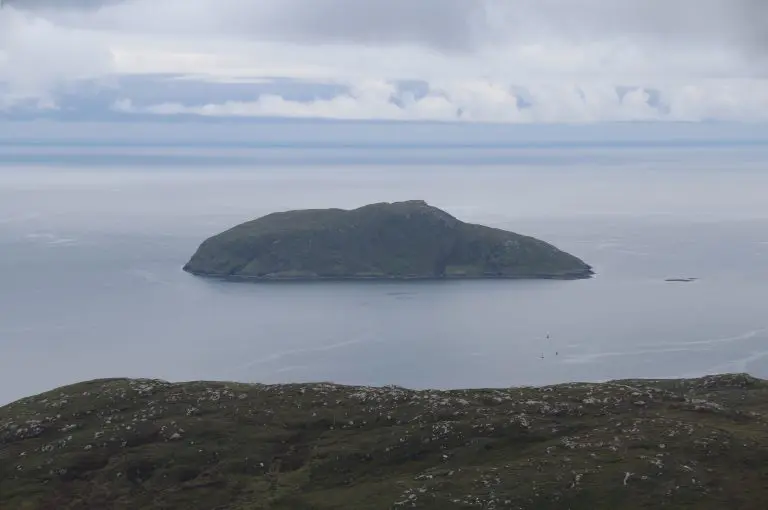
In the north, a sandy neck of land runs out to Eoligarry, with the great tidal strand of Tràigh Mhòr on one side, the beach that serves as the airport runway, and Atlantic dunes on the other. Off the south lie Vatersay and the uninhabited islands of Sandray, Pabbay, Mingulay and Berneray, ending at Barra Head, whose lighthouse marks the southern tip of the Hebrides.
History

People have lived on Barra since at least the Neolithic: a near-complete beaker pot of about 2500 BC was found during roadworks in the 1990s, and the hills hold standing stones and a large chambered cairn. Bronze Age burials and Iron Age roundhouses have been uncovered in the dunes at Allasdale, and a wheelhouse used into the 8th century has been excavated. Norse settlers arrived in the 9th century, and the island’s name may join their word ey, “island”, to that of St Finbarr. A carved stone from Cille Bharra, with a Celtic cross on one side and a runic inscription on the other, is a rare survival of the Norse-Gaelic world.
For centuries Barra was the land of the MacNeils, who built Kisimul Castle on its rock in Castlebay as their seat. In 1838 the debt-ridden chief sold the island to Colonel John Gordon of Cluny, who cleared many families in the following years, shipping some of them to Canada against their will. In 1937 the 45th chief of Clan MacNeil, an American architect, bought back much of the island and began restoring Kisimul, which is now cared for by Historic Environment Scotland. In 1941 the cargo ship SS Politician ran aground off nearby Eriskay with thousands of cases of whisky, inspiring Compton Mackenzie, who lived on Barra, to write Whisky Galore; the film was shot on the island in 1948, and Mackenzie is buried at Cille Bharra.
Watching the plane land on Tràigh Mhòr is a highlight for many visitors, as is the cockle beach itself when the tide is out.
Places to visit

A boat runs out from Castlebay to Kisimul Castle in summer, and the walk up Heaval gives a superb view of the castle, the bay and the southern isles. Watching the plane land on Tràigh Mhòr is a highlight for many visitors, as is the cockle beach itself when the tide is out. At Eoligarry, the restored medieval chapel of Cille Bharra stands among old graves above the sea. The west coast beaches at Halaman Bay, Allasdale and Seal Bay are among the loveliest in Scotland, and in summer boat trips sail to Mingulay to see its towering sea cliffs, puffins and the ruins of its abandoned village. In Castlebay, the Dualchas heritage centre tells the island’s story.
Getting there and around
Caledonian MacBrayne ferries sail from Oban to Castlebay, a crossing of about five hours, and a smaller ferry links Ardmhor in the north of Barra to Eriskay and the Uists. Loganair flies from Glasgow to the beach airport, with timetables that change with the tides, and from Benbecula. The ring road can be cycled in a few hours, and there is a bus service round the island and over the causeway to Vatersay.
Island life
Castlebay is the island’s village, with shops, hotels, a school, a hospital and the ferry pier. Fishing, especially for shellfish, crofting, tourism and public services provide most of the work, and the community is strongly Catholic and Gaelic-speaking. Music is everywhere, from ceilidhs in the hotel bars to the island’s summer music festival, and the regatta and the arrival of the ferry are still among the main events of the week. Few islands manage to be so small and so complete.
Wildlife
Among the wildlife most often recorded on Barra are Corncrake, Hooded Crow, Cuckoo, Whooper Swan, Brambling and Lapwing. See the Wildlife tab for the full list of 109 species and when to see them.
Tides
Now
—
Next high water
—
Next low water
—
Heights in metres relative to mean sea level; times are UK time. Not for navigation. Tide model: Open-Meteo (CC BY 4.0).
How to get to Barra
You can reach Barra by ferry, by air and on foot.
By ferry
By air
Plan your trip
Timetables change, so always check with the operator before you travel. We may earn a commission if you book through some of these links, at no extra cost to you.
Where to stay on Barra
12 places to stay on Barra, from hotels and B&Bs to hostels and campsites.
Check dates and prices-
Castlebay Hotel
Hotel · Isle of Barra
-
Craigard Hotel
Hotel · Isle of Barra
-
Heathbank Hotel
Hotel · Isle of Barra
-
Isle of Barra Hotel
Hotel · Isle of Barra
-
Tigh Grianach Bed & Breakfast
B&B / guest house
-
Tigh na Mara
B&B / guest house
-
Dunard Hostel
Hostel · Isle of Barra
-
Barra Sands
Campsite · Isle of Barra
-
Borve Camping and Caravan Site
Campsite
-
Croft 183
Campsite · Isle of Barra
-
Sgùrabhal Campsite
Campsite
-
Wavecrest Campsite
Campsite
We may earn a commission if you book through some of these links, at no extra cost to you. Places to stay are from OpenStreetMap; if one has closed or is missing, let us know. Data © OpenStreetMap contributors.
Wildlife
112 species recorded on the island
Highlights


All wildlife
Loading all 112 species…
Nothing on the list is usually seen this month.
Recordings from Wikimedia Commons, under Creative Commons licences; hover a Listen button for the recordist. Sightings are records shared with GBIF since 2000.
Watching wildlife responsibly. Keep your distance from seals, seabird colonies and cetaceans, stay quiet, and never feed or chase wildlife. See the Scottish Marine Wildlife Watching Code.