


Islands of Furness
9 islands · England
Island Passport
How many of the 9 islands in Islands of Furness can you collect?
0 of them collected by explorers so far
The Islands of Furness lie in Morecambe Bay off the Cumbrian coast of North West England, a tidal group closely associated with the industrial town of Barrow-in-Furness, itself built around a former island, Barrow Island, absorbed into the town’s docks during the nineteenth-century shipbuilding boom that made Barrow internationally famous for submarine construction, a heritage that continues today through BAE Systems’ ongoing production of Royal Navy submarines at the same yards first established in the Victorian era.

Visiting
The largest island in the group, Walney Island, shelters Barrow’s harbour and is connected to the mainland by a road bridge, its long, low profile providing a natural breakwater that made large-scale shipbuilding possible in the sheltered channel behind it. Piel Island, reachable by ferry from Roa Island, is home to the ceremonial title of “King of Piel”, traditionally bestowed on the landlord of the island’s only pub, the Ship Inn, in a ceremony involving a sword and helmet, a quirky and enduring local custom that continues to draw curious visitors to this otherwise quiet, sparsely populated island.

History
Piel Island itself preserves the ruins of a 14th-century fortified warehouse, Piel Castle, built by the monks of nearby Furness Abbey to protect valuable cargoes of grain, wine and wool shipped in from Ireland, and briefly seized dramatic historical significance in 1487 when the pretender Lambert Simnel landed there with a force of German mercenaries in a failed Yorkist attempt to seize the English throne, a campaign that ended in defeat at the Battle of Stoke less than two weeks later.
More about Islands of Furness
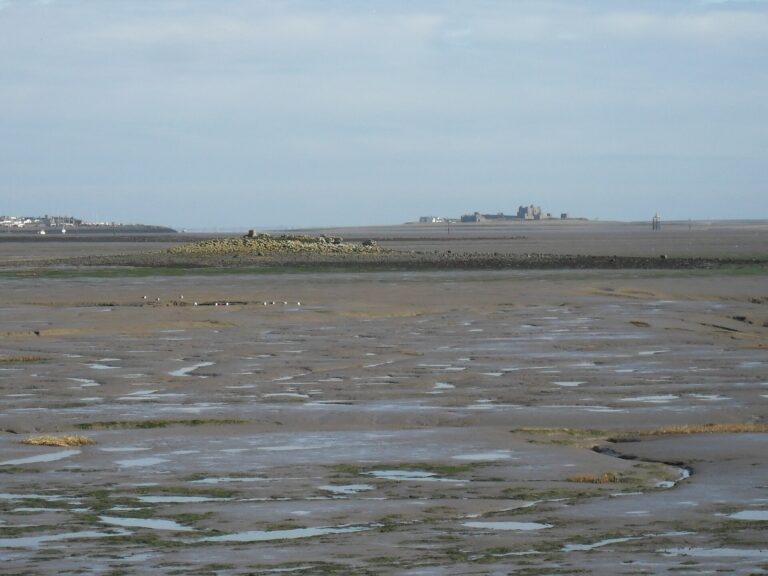
Foulney Island, Sheep Island, and Chapel Island are all tidal, accessible on foot at low tide with appropriate local knowledge, though fast-moving tides and treacherous quicksand make such crossings genuinely hazardous without a guide, a danger that has claimed the lives of unwary walkers over the centuries and continues to require the services of an official Queen’s Guide to the Sands for larger organised crossings of the wider bay. Smaller islets including Headin Haw and Dova Haw complete the group, their Old Norse-derived names, “haw” meaning a small hill or mound, reflecting the centuries of Scandinavian settlement that shaped place names throughout this stretch of the Cumbrian coast.

Morecambe Bay as a whole is one of the largest expanses of intertidal mudflat in Britain, internationally important for wading birds and shellfish, and the Islands of Furness sit at the heart of this dynamic, tide-dominated landscape, their exposed sands supporting vast cockle beds that have historically supported a significant local fishing industry, alongside internationally important numbers of oystercatchers, knot, and dunlin feeding on the bay’s rich invertebrate life each winter.
This combination of industrial shipbuilding heritage stretching from Victorian submarine pioneers to the present day, a genuinely ancient tidal ceremonial tradition still marked on Piel Island, a dramatic medieval and Tudor-era history, and rich estuarine wildlife makes the Islands of Furness one of the most distinctive and historically layered island groups on England’s entire west coast.
South Walney, at the island’s southern tip, is now managed as a nature reserve by Cumbria Wildlife Trust, its shingle and dune habitats supporting one of Europe’s largest colonies of lesser black-backed and herring gulls alongside a resident population of grey seals that haul out on the sandbanks nearby, among the most southerly regular seal colonies on England’s west coast. The islands’ medieval history was shaped above all by Furness Abbey, once one of the wealthiest Cistercian monasteries in England, whose monks controlled much of the surrounding land and coastline, including Piel Island itself, until the abbey’s dissolution under Henry VIII in 1537 transferred its extensive holdings into royal and, eventually, private hands.
Roa Island, linked to the mainland by a Victorian causeway, was once considered as a potential Irish Sea packet station before Fleetwood was chosen instead, and today serves chiefly as a base for the RNLI lifeboat station covering this stretch of treacherous, fast-tiding coastline, alongside a scatter of moorings used by local sailing and fishing boats.
The biggest islands in Islands of Furness
By area (acres)
- 1 Barrow Island 23,567
- 2 Walney Island 3,210
- 3 Foulney Island 40
- 4 Piel Island 26
- 5 Sheep Island (Furness) 15
- 6 Roa Island 7
- 7 Chapel Island 7
- 8 Dova Haw 1
By population (people)
- 1 Walney Island 10,519
- 2 Roa Island 100
- 3 Piel Island 10
Every island in Islands of Furness
Island No.
893
Not yet collected
Tidal
Barrow Island
Islands of Furness
Barrow Island is a former island in Barrow-in-Furness, Cumbria, England, now a district of the town after being connected to the mainland…
 Island No.
29
Not yet collected
Tidal
Chapel Island
Islands of Furness
Chapel Island is one of the Islands of Furness, a small tidal island off the coast of Cumbria, England, within the wider…
 Island No.
52
Not yet collected
Saltwater
Dova Haw
Islands of Furness
Dova Haw, also known as Crab Island, is one of the Islands of Furness, a small tidal islet off the coast of…
Island No.
78
Not yet collected
Tidal
Foulney Island
Islands of Furness
Foulney Island is a low-lying area of grass and shingle around a mile south-east of Roa Island , off the southern tip…
 Island No.
97
Not yet collected
Tidal
Headin Haw
Islands of Furness
Headin Haw, also spelled Headen Haw, is one of the Islands of Furness, a small tidal island around 200 metres off the…
Island No.
175
Not yet collected
Tidal
Piel Island
Islands of Furness
Piel Island lies in Morecambe Bay, around half a mile off the southern tip of the Furness Peninsula in Cumbria, England, and…
 Island No.
294
Not yet collected
Tidal
Roa Island
Islands of Furness
Roa Island lies just over half a mile south of the village of Rampside, at the southern tip of the Furness Peninsula…
 Island No.
339
Not yet collected
Tidal
Sheep Island (Furness)
Islands of Furness
Sheep Island is a small, uninhabited grassy island of around fifteen acres lying just a few hundred metres off the shore of…
 Island No.
222
Not yet collected
Saltwater
Walney Island
Islands of Furness
Walney Island, also known as the Isle of Walney, lies off the west coast of England at the western edge of Morecambe…
