

Hirta
Hirta is the largest island of St Kilda, the remote archipelago far out in the Atlantic west of the Outer Hebrides. It is about 3.4 kilometres across, covering around 1,650 acres, and was home to nearly all of St Kilda’s people until 1930, when the last 36 islanders were evacuated to the mainland. The whole archipelago belongs to the National Trust for Scotland and is a World Heritage Site for both its natural and its cultural importance.
Landscape
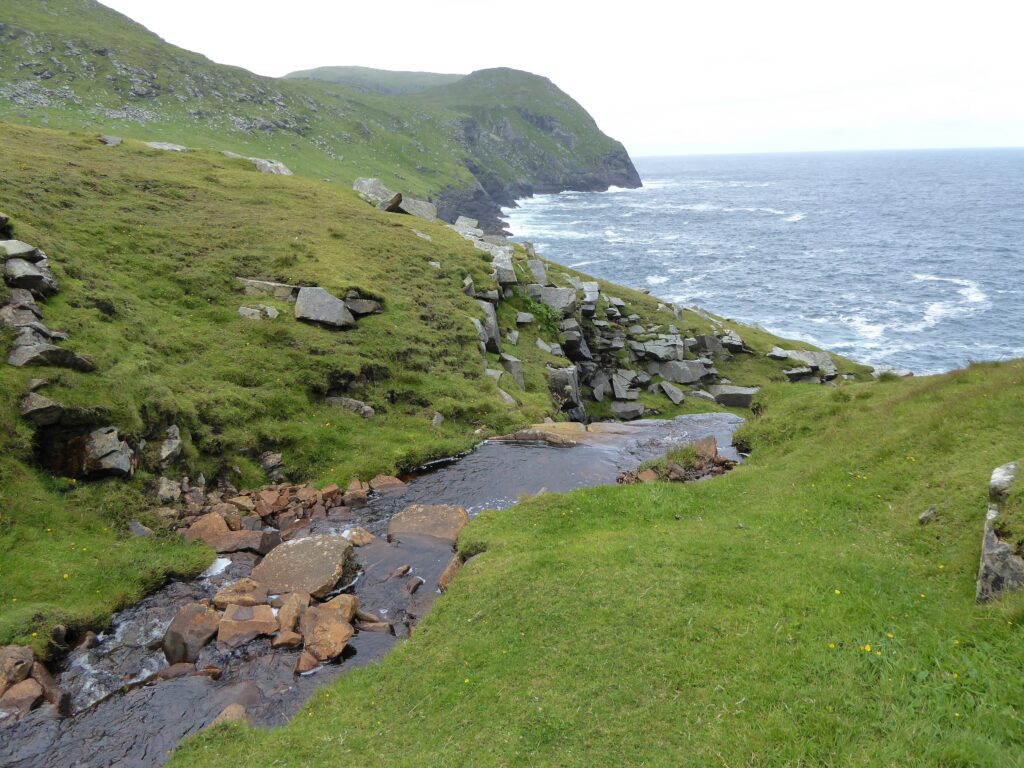
Hirta is ringed by tremendous cliffs, rising sheer out of deep water, and the cliffs of Conachair, at over 400 metres, are the highest sea cliffs in Britain. The only real landing place is in the shelter of Village Bay on the south-east side; on the north coast, Glen Bay slopes more gently to the sea, but landing there is difficult in any swell. Around the island stand stacks and islets such as Dùn, Bradastac and Mina Stac, with Soay just to the north-west.
Island life
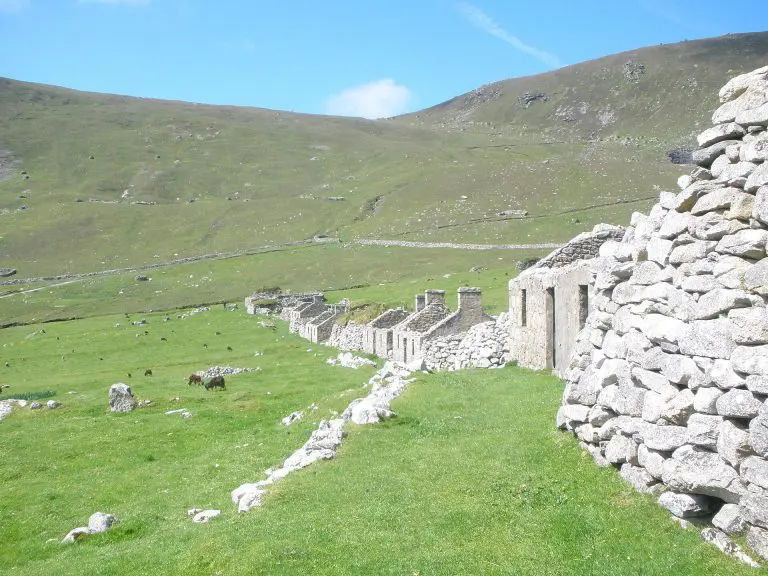
In the late 17th century about 180 people lived on Hirta, and 112 in 1851. They lived in the village above Village Bay, along a curved street of stone houses, and stored food in hundreds of cleits, small stone huts dotted across the hillsides. Their way of life depended on seabirds: they climbed the cliffs and stacks to catch fulmars, gannets and puffins and collect their eggs. The men met each morning in a “parliament” to decide the day’s work. Contact with the outside world was rare, and messages were sometimes sent in “mailboats”, small wooden boats set adrift in the hope they would reach the mainland.
Illness, emigration and the difficulty of island life slowly reduced the population, and on 29 August 1930 the remaining islanders asked to be taken off.
More about Hirta

Illness, emigration and the difficulty of island life slowly reduced the population, and on 29 August 1930 the remaining islanders asked to be taken off. Today the village street has been partly restored, a small museum tells the islanders’ story, and a military station is based on the island. Hirta has its own subspecies of wren and of field mouse.
Visiting
Day trips to St Kilda run in summer from Harris and Skye, weather permitting, landing at Village Bay. It is a long and often rough crossing, but an unforgettable experience. You can collect Hirta as a landing or a sighting in your Island Passport.
Wildlife and area
Hirta is home to the wild Soay sheep, as well as huge colonies of Fulmar, Puffin, Gannet and Leach’s petrels. Look out for great skuas and Grey Seal. Other islands nearby include Bradastac, Mina Stac, Dùn and Soay.
Tides
Now
—
Next high water
—
Next low water
—
Heights in metres relative to mean sea level; times are UK time. Not for navigation. Tide model: Open-Meteo (CC BY 4.0).
Wildlife
109 species recorded on the island
Highlights



Island specials

All wildlife
Loading all 109 species…
Nothing on the list is usually seen this month.
Recordings from Wikimedia Commons, under Creative Commons licences; hover a Listen button for the recordist. Sightings are records shared with GBIF since 2000.
Best seen at
Watching wildlife responsibly. Keep your distance from seals, seabird colonies and cetaceans, stay quiet, and never feed or chase wildlife. See the Scottish Marine Wildlife Watching Code.


