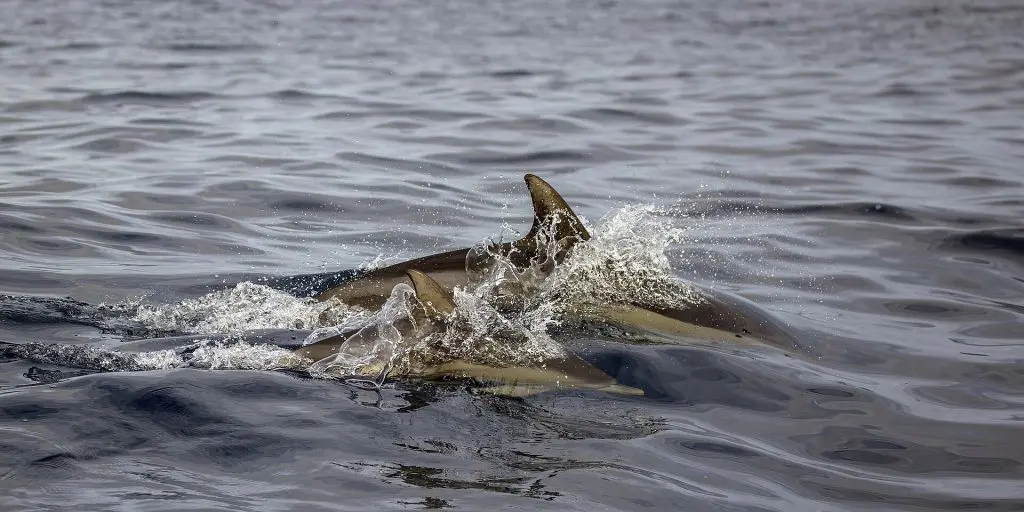


Common Dolphin
The common dolphin (Delphinus delphis) is, despite its name, not the dolphin most people picture first, that honour tends to go to the bottlenose, yet it is by some distance the most numerous dolphin species on the planet, with a global population estimated at around six million animals. Around British and Irish waters it is most frequently encountered further offshore and to the west and south, particularly in the Celtic Sea, the Bay of Biscay approaches and around Cornwall, rather than in the sheltered coastal waters favoured by bottlenose dolphins.
An Hourglass in the Water
Common dolphins are strikingly patterned compared with most other dolphin species, marked along each flank with a distinctive hourglass pattern in pale grey, yellow or gold shading into a darker grey toward the tail, set against a dark back and pale belly, a combination that makes the species relatively easy to identify even at a distance in good light. This bold patterning, unusual among cetaceans, made the common dolphin a recognisable and culturally significant animal even in antiquity, appearing repeatedly in Greek and Roman art, including murals from the ancient Minoan civilization.
A Once-Divided Species Reunited
For several decades, scientists recognised separate short-beaked and long-beaked common dolphin species, but more recent genetic research has shown that long-beaked populations around the world are not closely related to one another and likely evolved independently and repeatedly from short-beaked ancestors, meaning the traditional species split no longer reflects genuine evolutionary relationships. All common dolphins found in British and Irish waters belong to the short-beaked form, now simply treated as regional variation within a single, wide-ranging species rather than a distinct taxonomic group.
Highly Social, Often in Large Numbers

Common dolphins are intensely social animals, typically travelling in groups of dozens to hundreds of individuals and sometimes gathering into “megapods” of well over a thousand animals when food is abundant, a scale of aggregation rarely matched by any other dolphin species found in British waters. Fast, acrobatic and frequently seen bow-riding vessels, common dolphins are among the most reliably encountered cetaceans on boat-based wildlife trips off the southwest coast of England and Ireland, their energetic surface behaviour making large groups conspicuous from a considerable distance.
Where to see it on the islands
On Search Isle, the common dolphin is recorded on 144 islands. They are spread across Scotland (87), England (25), Wales (16), Ireland (11) and Crown Dependencies (5).
The most records come from Staffin Island (Highland, 525 records), Burgh Island (Devon, 107 records), Gateholm (Pembrokeshire, 81 records) and Skokholm Island (Pembrokeshire, 74 records). These counts reflect where people have looked as well as where the animal lives: busy islands, and those with bird observatories, have far more records than remote ones.
Through the year
The common dolphin is usually seen from May to October.
Other dolphins and porpoises
The common dolphin is one of 6 dolphins and porpoises on Search Isle, alongside Atlantic White-sided Dolphin, Bottlenose Dolphin, Harbour Porpoise, Risso’s Dolphin and White-beaked Dolphin.
