Rosevear
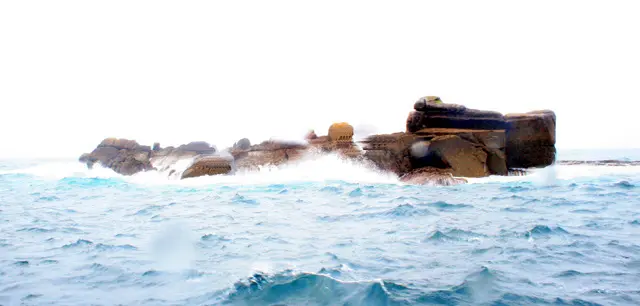
Rosevear is the largest of the Western Rocks, a scattered group of reefs and islets at the far south-western extremity of the Isles of Scilly, beyond even the Bishop Rock lighthouse.
Landscape
Despite being the largest island in the group, it covers just 1.6 acres, a flat-topped outcrop rising no more than 5 metres above the sea, owned today by the Duchy of Cornwall and closed to public landing.
History

Rosevear’s small size belies a genuinely dramatic history. In 1709 and 1710 it served as a salvage camp following the catastrophic wreck of a Royal Navy fleet on the Western Rocks the previous year, one of the worst maritime disasters in British naval history, in which four ships and around 1,400 sailors were lost. Local legend holds that the island is haunted by the opera singer Ann Cargill, who drowned nearby in the wreck of the Nancy in 1784, her ghost said to walk the rocks where she came ashore only to die of exposure.

Rosevear’s more constructive chapter began in April 1847, when Trinity House decided to build a lighthouse on the Bishop Rock, the notorious reef that had wrecked so many ships approaching the Isles of Scilly from the Atlantic. Rosevear, close enough to the Bishop Rock yet stable enough to support construction work, was chosen as the operational base for the project, housing workers’ lodges, a workshop and a smith’s forge across two phases of building, 1847 to 1850 and 1851 to 1858. The remains of these structures still stand on the island today and were designated a scheduled monument in 1997, a rare survival of the infrastructure behind one of the great Victorian lighthouse engineering projects.
Wildlife and area
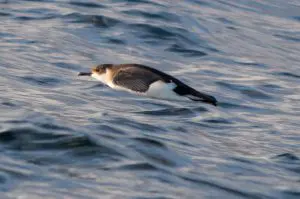
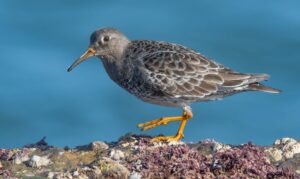
Since 1971, Rosevear has held Site of Special Scientific Interest status, protecting a seabird colony of real significance: a 2006 survey recorded 129 occupied storm-petrel nest sites, making it home to the third-largest colony of European storm petrel anywhere in England. Its shag colonies are similarly important, and the island receives a steady passage of migrant birds each year. The waters and rocks around Rosevear support Grey Seal alongside the storm petrels, part of the same wildlife-rich environment found across the wider Isles of Scilly, including nearby islands such as Zantman’s Rock, another of the small, uninhabited outcrops that make the Western Rocks one of the most remote and least-visited corners of England.
Tides
Now
—
Next high water
—
Next low water
—
Heights in metres relative to mean sea level; times are UK time. Not for navigation. Tide model: Open-Meteo (CC BY 4.0).
Wildlife
25 species recorded on the island
Highlights


All wildlife
Loading all 25 species…
Nothing on the list is usually seen this month.
Recordings from Wikimedia Commons, under Creative Commons licences; hover a Listen button for the recordist. Sightings are records shared with GBIF since 2000.
Watching wildlife responsibly. Keep your distance from seals, seabird colonies and cetaceans, stay quiet, and never feed or chase wildlife. See the WiSe Scheme guidance for watching marine wildlife.