
Dun (St Kilda)
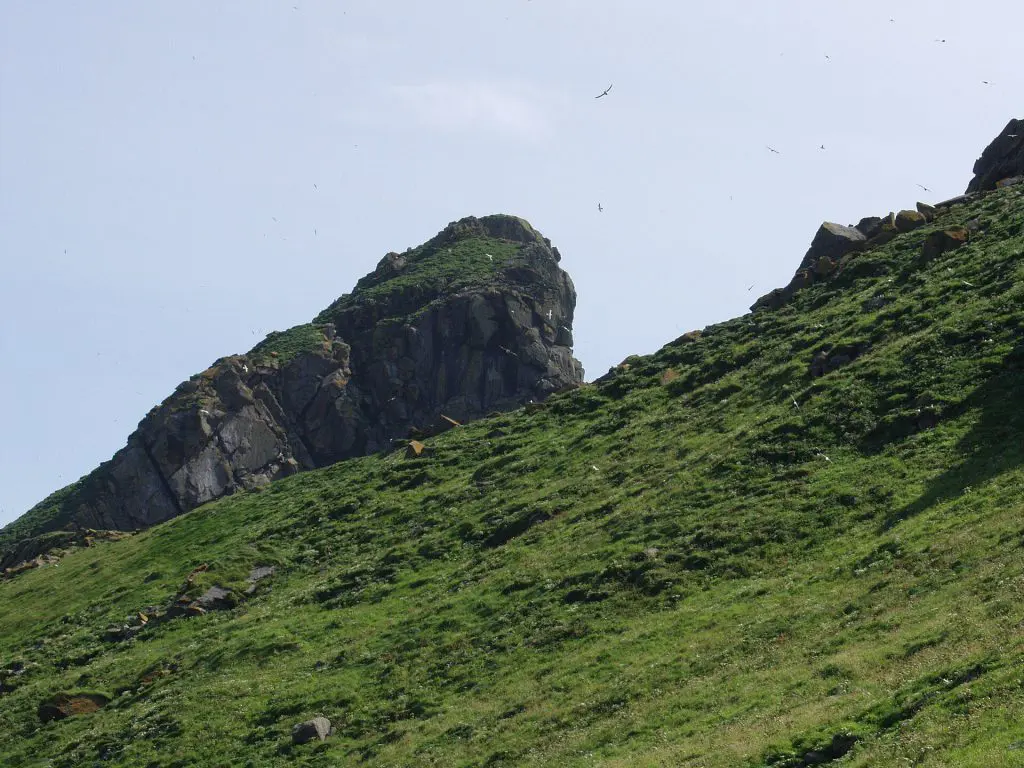
Dùn is a long, narrow island in the St Kilda archipelago, nearly a mile long, lying just off the south-east corner of Hirta, the main island. It forms a natural breakwater sheltering Village Bay, where the St Kildans lived, from the prevailing south-westerly winds, and it is home to the largest colony of fulmars in Britain.
Landscape

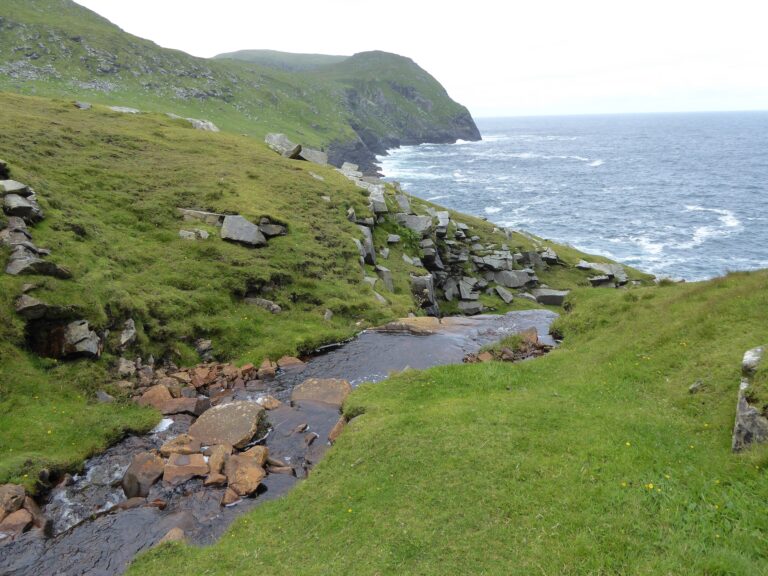
Dùn is almost joined to Hirta at Ruaival, but the two are separated by a narrow channel, Caolas an Dùin, “the strait of Dùn”. Because the wild Soay sheep on Hirta cannot cross it, Dùn is much more heavily vegetated than its neighbour, with thick grass and wildflowers on its slopes. It was once joined to Hirta by a natural arch. One story says the arch was smashed by a galleon fleeing the defeat of the Spanish Armada in 1588, but the more likely explanation is that it was swept away by one of the fierce storms that batter St Kilda every winter.
History
The island’s name simply means “fort” in Gaelic. Old maps show the fort at Gob an Dùin, the seaward end of the island, but no trace of it has survived. Like the other islands and stacks of St Kilda, Dùn was an important source of seabirds and eggs for the St Kildans, who were expert climbers and fowlers until they left the islands in 1930.
Before 1828, St Kilda was the only place in the British Isles where fulmars bred.
More about Dùn
Before 1828, St Kilda was the only place in the British Isles where fulmars bred. Since then they have spread right around the coasts of Britain and Ireland, to places such as Fowlsheugh in Aberdeenshire, but Dùn still holds the largest colony. St Kilda is owned by the National Trust for Scotland and is a World Heritage Site for both its natural and its cultural importance.
Visiting

Landing on Dùn is not normally possible for visitors, but it is easy to see from Village Bay on Hirta. Day trips to St Kilda run in summer from Harris and Skye, weather permitting. You can collect Dùn as a landing or a sighting in your Island Passport.
Wildlife and area
As well as thousands of Fulmar, Dùn has large numbers of Puffin, which burrow in its grassy slopes, along with Razorbill, guillemots and kittiwakes. At night, Leach’s petrels and storm petrels come ashore to their burrows. Other islands nearby include Sgeir Cùl an Rubha, Stac Levenish and Hirta.
Tides
Now
—
Next high water
—
Next low water
—
Heights in metres relative to mean sea level; times are UK time. Not for navigation. Tide model: Open-Meteo (CC BY 4.0).
Wildlife
18 species recorded on the island
Highlights


All wildlife
Loading all 18 species…
Nothing on the list is usually seen this month.
Recordings from Wikimedia Commons, under Creative Commons licences; hover a Listen button for the recordist. Sightings are records shared with GBIF since 2000.
Watching wildlife responsibly. Keep your distance from seals, seabird colonies and cetaceans, stay quiet, and never feed or chase wildlife. See the Scottish Marine Wildlife Watching Code.