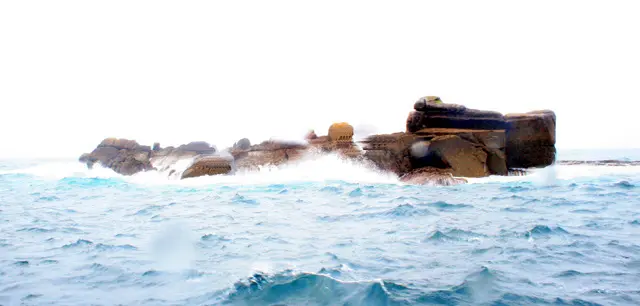
Hellweathers
Hellweathers is a group of rocks on the eastern side of the Western Rocks, close to Annet and Melledgan, whose name well describes the conditions here in a winter gale. Like the rest of the Western Rocks, it is uninhabited, bare and battered by the Atlantic, and today it is a refuge for seabirds and grey seals.
Landscape

The Western Rocks are the scatter of granite islets and reefs at the south-western end of the Isles of Scilly, beyond St Agnes and Annet, in the full path of the Atlantic swell. They have wrecked more ships than almost any other stretch of the British coast, and the Bishop Rock lighthouse was built at their outer edge to warn ships away.
History
In December 1907 the Thomas W. Lawson, the only seven-masted schooner ever built, was wrecked nearby off Annet, spilling her cargo of oil and killing many seabirds; the reefs around Hellweathers are part of the same dangerous ground. The worst disaster in these waters came in 1707, when Admiral Shovell’s fleet struck the Western Rocks with the loss of between 1,400 and 2,000 lives.
The worst disaster in these waters came in 1707, when Admiral Shovell’s fleet struck the Western Rocks with the loss of between 1,400 and 2,000 lives.
Wildlife
The Western Rocks have been a Site of Special Scientific Interest since 1971 and are owned by the Duchy of Cornwall and managed by the Isles of Scilly Wildlife Trust. Landing is not allowed, to protect their breeding seabirds and seals.
Visiting

There is no landing on the Western Rocks. Seabird and seal-watching trips from St Mary’s and St Agnes run out among them in calm summer weather, and trips to the Bishop Rock pass close by. You can collect Hellweathers as a sighting in your Island Passport.
Wildlife and area
The rocks hold breeding shags, storm petrels and great black-backed gulls, and grey seals haul out and pup on the ledges in autumn. Nearby islands include Melledgan, Great Crebawethan and Little Crebawethan.
Tides
Now
—
Next high water
—
Next low water
—
Heights in metres relative to mean sea level; times are UK time. Not for navigation. Tide model: Open-Meteo (CC BY 4.0).
Wildlife
4 species recorded on the island
Highlights


All wildlife
Loading all 4 species…
Nothing on the list is usually seen this month.
Recordings from Wikimedia Commons, under Creative Commons licences; hover a Listen button for the recordist. Sightings are records shared with GBIF since 2000.
Watching wildlife responsibly. Keep your distance from seals, seabird colonies and cetaceans, stay quiet, and never feed or chase wildlife. See the WiSe Scheme guidance for watching marine wildlife.