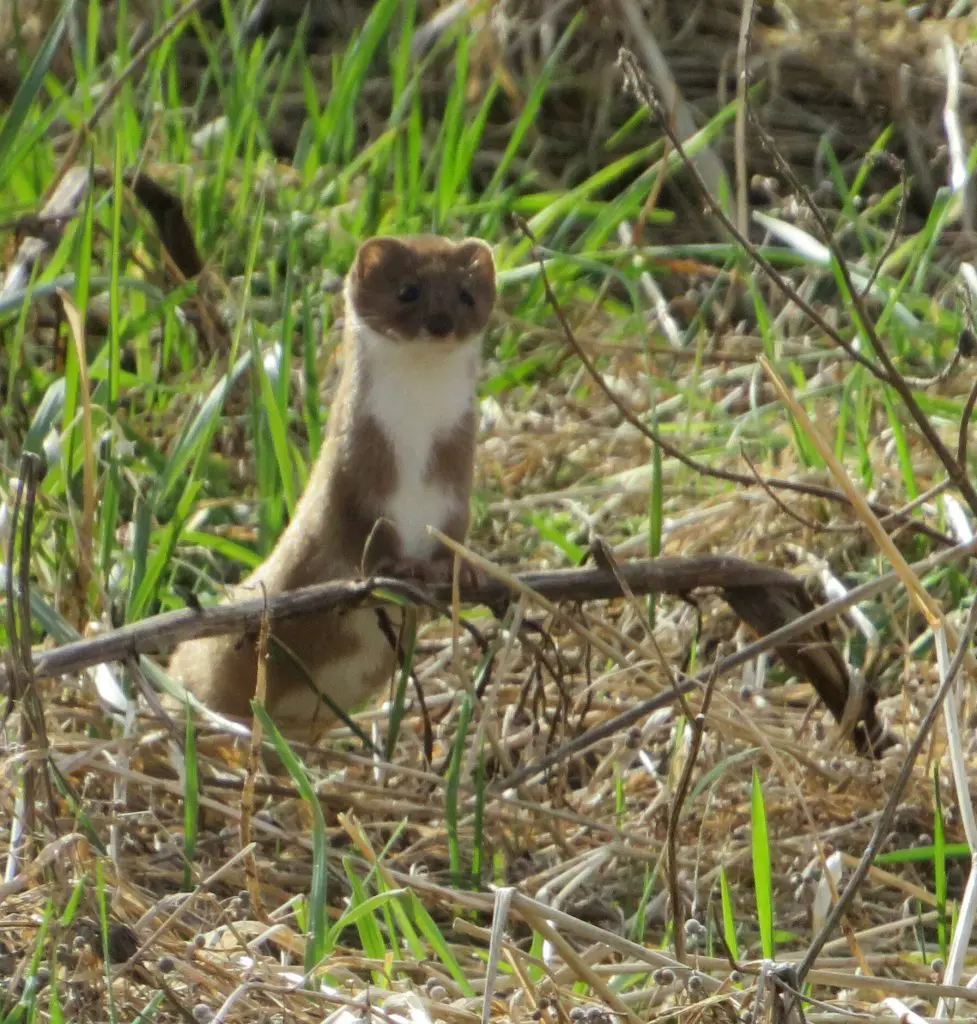


Weasel
The weasel, formally the least weasel (Mustela nivalis), is the smallest member of the entire order Carnivora found anywhere in the world, a slender, fast-moving predator so slight that it can pursue mice and voles directly into their own burrows. Reddish-brown above with a sharp, straight-edged white underside and, unlike the related stoat, no black tip to its short tail, the weasel is found across most of mainland Britain, where it remains a familiar if rarely seen countryside predator.
A Genuine Absence From Ireland

One of the more interesting biogeographical quirks of British and Irish wildlife is that the true weasel has never established itself in Ireland at all, unable to cross the sea barrier that separated Ireland from Britain before either species could naturally spread that far west after the last ice age. Confusingly, the stoat, which is present in Ireland, is often called “the weasel” in everyday Irish usage despite being a distinctly different, larger species, a naming overlap that has caused genuine confusion for generations of visitors comparing British and Irish wildlife.
A Formidable Hunter Despite Its Size
Weasels feed primarily on small rodents, taking mice and voles in numbers disproportionate to their own tiny size, and will also kill rabbits, birds and eggs when the opportunity arises, hunting with a speed and ferocity that has made the species a recurring figure in folklore and legend across the cultures of its wide Eurasian and North American range. Unlike the stoat, weasels rarely turn white in winter even in the colder, northern parts of their range, though some high-altitude and far northern populations do develop a white coat matching the stoat’s seasonal ermine transformation.
A Species Rarely Seen on British Islands
Because weasels are considerably less able to cross open water than the larger, more robust stoat, they are notably scarce or entirely absent from many British islands that stoats have successfully colonised, making island distribution one of the more reliable ways to distinguish the two similar-looking species without a close view. Where they do occur on islands connected to the mainland by only a narrow crossing, weasels play the same important small-rodent control role they perform across the wider British countryside, an outsized ecological impact for one of the smallest carnivorous mammals in the world.
Where to see it on the islands
On Search Isle, the weasel is recorded on 8 islands. They are spread across Wales (4), England (2) and Scotland (2).
The most records come from Isle of Wight (Hampshire, 45 records), Anglesey (North Coast, 37 records), Isle of Skye (Inner Hebrides, 14 records) and Thorn Island (Pembrokeshire, 11 records). These counts reflect where people have looked as well as where the animal lives: busy islands, and those with bird observatories, have far more records than remote ones.
Through the year
The weasel can be seen all year round on the islands.
Other carnivores
The weasel is one of 9 carnivores on Search Isle, alongside American Mink, Eurasian Otter, European Badger, Pine Marten, Polecat, Red Fox, Scottish Wildcat and Stoat.
