


Mugdrum Island
Mugdrum Island lies in the Firth of Tay on the east coast of Scotland, opposite the town of Newburgh in Fife. It is low-lying and reedy, covering around 56 acres, and it is the only significant island in the firth, splitting the Tay into two channels, the North Deep and the South Deep. Once a farm, it is now a nature reserve.
Landscape

Mugdrum is a flat island of reed beds, grassland and mudflats, surrounded by the tidal waters of the upper Firth of Tay. The reed beds of the Tay, which stretch along the northern shore of the firth, are among the largest in Britain. From the island there are views to Newburgh, the Ochil Hills and the Carse of Gowrie across the water.
History
Mugdrum once belonged to Lindores Abbey, the great medieval abbey at Newburgh, and is named Redinche, meaning “red island” or “reed island”, in the abbey’s foundation charter. The abbey’s founder, David, Earl of Huntingdon, gave the monks fishing rights around the island, while keeping a fish trap in the channel between the island and the southern shore for his own household. In the 17th century the island became part of the Mugdrum estate near Newburgh, from which it takes its name.
For centuries the island was farmed, growing cereals, potatoes and turnips, and its reeds were cut for thatching roofs.
More about Mugdrum Island
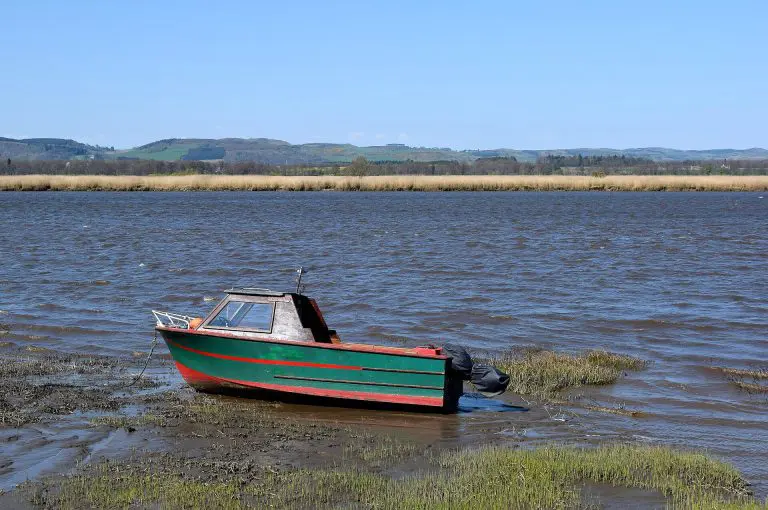
For centuries the island was farmed, growing cereals, potatoes and turnips, and its reeds were cut for thatching roofs. The last tenant left in 1926. Today Mugdrum is a nature reserve looked after by the Tay Valley Wildfowlers’ Association. Lindores Abbey, whose ruins still stand at Newburgh, has a claim to be the birthplace of Scotch whisky, as the earliest written record of whisky-making in Scotland, from 1494, mentions one of its monks.
Visiting
There is no ferry to Mugdrum Island. It can be seen from Newburgh’s waterfront and from the hills above the town. You can collect Mugdrum Island as a landing or a sighting in your Island Passport.
Wildlife and area
The Firth of Tay is excellent for wildfowl and waders, including pink-footed geese, greylag geese, Redshank and Curlew, and the reed beds are home to Reed Bunting, Sedge Warbler and Marsh Harrier. Look out for Harbour Seal and Grey Seal on the sandbanks. Other islands nearby include Moncreiffe Island and the South Inch.
How to get to Mugdrum Island
You can reach Mugdrum Island on foot.
Plan your trip
Timetables change, so always check with the operator before you travel. We may earn a commission if you book through some of these links, at no extra cost to you.
Wildlife
66 species recorded on the island
Highlights


All wildlife
Loading all 66 species…
Nothing on the list is usually seen this month.
Recordings from Wikimedia Commons, under Creative Commons licences; hover a Listen button for the recordist. Sightings are records shared with GBIF since 2000.

