

Amhuinnsuidhe Castle
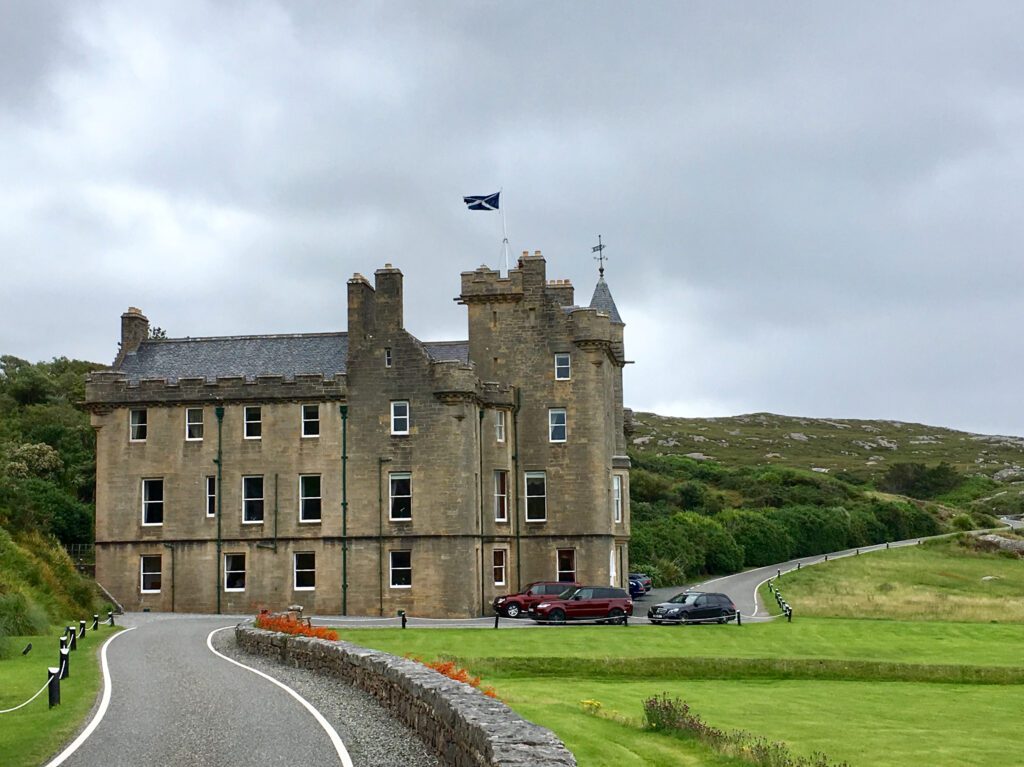
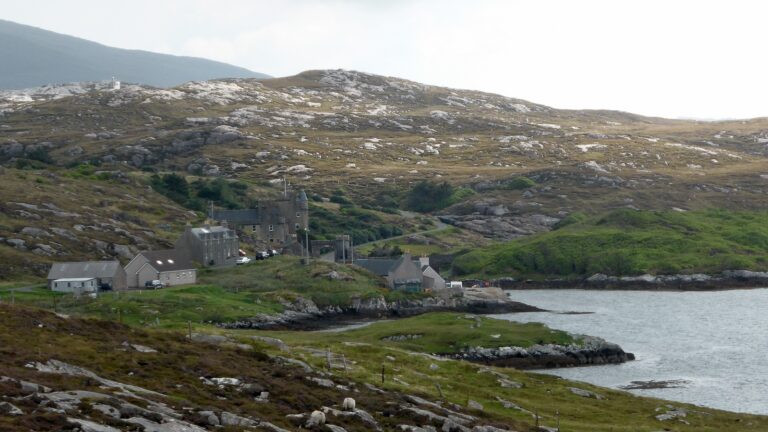
Amhuinnsuidhe Castle stands on the shore of West Loch Tarbert in North Harris, on Lewis and Harris in the Outer Hebrides. This grand Victorian house, squeezed between the sea and the steep hillside behind it, is one of the most surprising sights in the Hebrides: a baronial mansion of pale imported stone, with turrets and crow-stepped gables, beside a single-track road in one of the wildest landscapes in Britain.
History
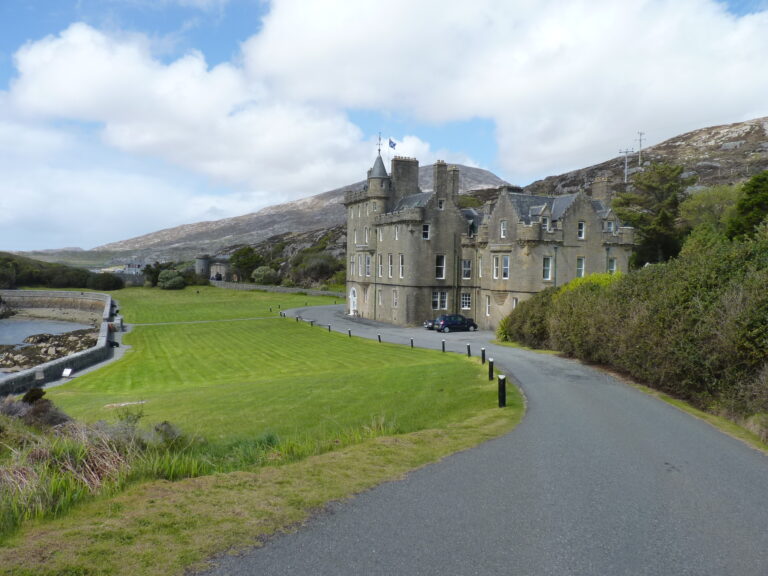
The house was originally called Fincastle. It was built between 1864 and 1867 for Charles Murray, 7th Earl of Dunmore, whose grandfather George Murray, 5th Earl of Dunmore, had bought Harris in 1834. The architect was David Bryce, the leading designer of Scottish baronial country houses in the Victorian era. The Dunmores are also remembered for encouraging the Harris tweed industry: the Countess of Dunmore helped introduce the cloth woven by island women to buyers in London.
In 1912 the playwright J. M. Barrie, author of Peter Pan, stayed at the castle, and visits to nearby Loch Voshimid inspired his play Mary Rose, the story of a girl who vanishes on a Hebridean island. Barrie later wrote of the loch, ‘where we found Mary Rose’.
In 2003 the castle and its fishing rights were bought by the Amhuinnsuidhe Castle Estate, while the surrounding North Harris Estate passed into community ownership through the North Harris Trust, one of a number of community land buyouts in the Hebrides. The castle is now run as a venue for fishing and shooting parties, weddings and events. In 2024 it was used as a filming location for the Gaelic television drama An t-Eilean.
The building

Level ground is scarce here, and the house is squeezed into a narrow strip between the sea and the hill, with walls holding back both. For the same reason the main road runs right past the front door, very unusual for a country house. The four-storey main block has a corner turret and rounded corners, and the lower wings on either side give the impression of a house that grew over centuries. It is built of imported freestone, and it was listed at Category A in 1971.
North Harris
North Harris is the most mountainous part of the Outer Hebrides, with more than thirty peaks over a thousand feet, including Clisham, at 799 metres the highest point on the island. Its glens, lochs and rivers are famous for salmon and sea trout, and the castle sits at the mouth of a river where salmon can be seen leaping up a waterfall into the sea loch below.
Visiting

The castle is reached by the single-track B887, which leaves the main road near Tarbert and winds west along the shore to Hushinish, passing directly in front of the castle. The house is private, but it can be seen from the road, and the drive itself is one of the most beautiful in the Hebrides, ending at the white sands of Hushinish beach.
Wildlife
North Harris is one of the best places in Britain to see golden and white-tailed eagles, and there is an eagle observatory in Glen Meavaig, near the castle. Red deer roam the hills, and otters and seals are common along the shore.
About island castles
All castles →For centuries islands were not remote but at the centre of things, on the sea roads that carried kings, clans and armies, and many were guarded by castles. Here you will find the castles on the islands we cover, from the strongholds of the Lords of the Isles and the tower houses of Highland clans…