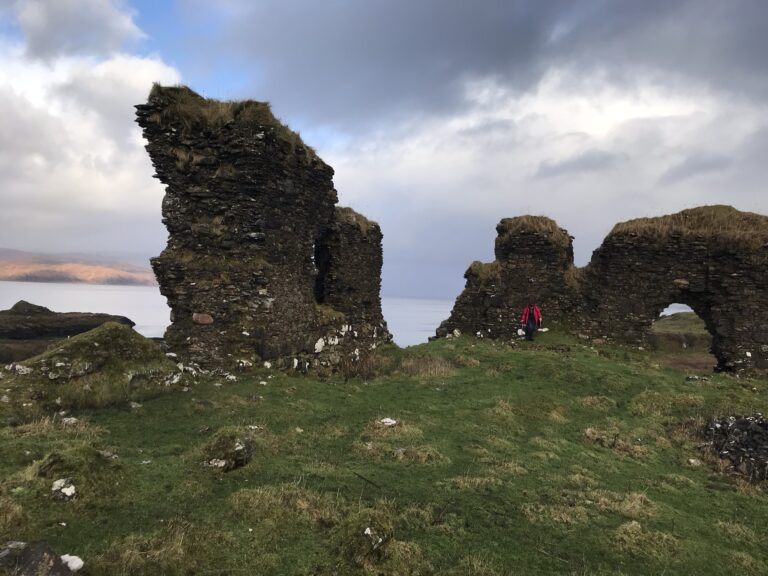
Coeffin
Castle Coeffin stands on a rocky promontory on the north-west coast of Lismore, the long, fertile island in Loch Linnhe, looking across the water to Glensanda and the hills of Morvern. Its ivy-covered walls, rising from the rock above a small bay, are among the most atmospheric castle ruins in Argyll.
History
Tradition says that the castle was built on the site of a Viking fortress, and that its name comes from Caifen, a Danish or Norse prince. A local legend tells that his sister haunted the castle until her remains were carried back to Norway to be buried beside her lover. The Ordnance Gazetteer of Scotland, in 1892, described the ruin as ‘a very ancient Scandinavian fortalice’, reflecting the long-held belief in its Norse origins.
The castle that survives was built in the thirteenth century, probably by the MacDougalls of Lorn, descendants of Somerled, who held much of Argyll and the islands. Lismore was important to their lordship: it was the site of St Moluag’s Cathedral, the seat of the Bishop of Argyll, and its rich limestone soils made it one of the most productive islands on the west coast.
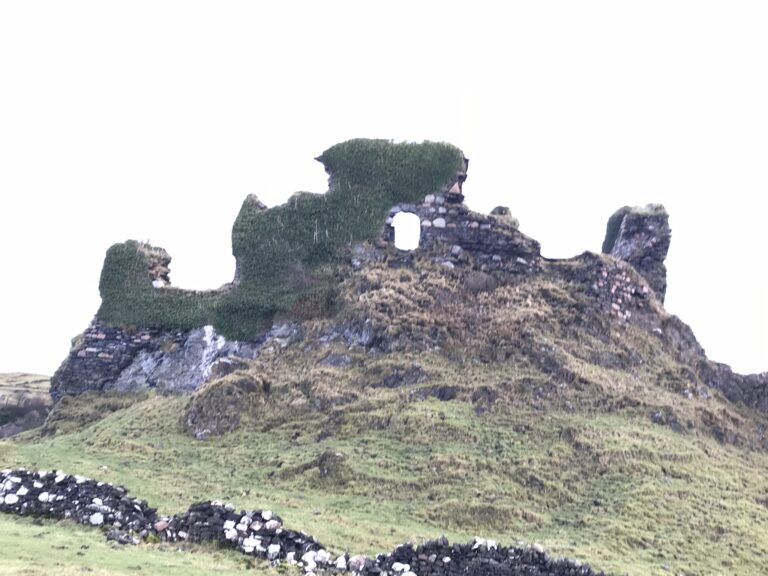
The first written record of the castle comes from 1469 to 1470, when it was granted by Colin Campbell, 1st Earl of Argyll, to Sir Colin Campbell of Glenorchy, by which time the Campbells had replaced the MacDougalls as the dominant power in the region. It is unlikely that the castle was lived in after the medieval period.
The ruins
The remains consist of an oblong hall-house and an irregular bailey, or walled courtyard. The great hall measures about 20 by 10 metres, with walls more than two metres thick. The bailey was mostly built later than the hall. An outside stair probably led from the entrance in the north-east wall down to the bailey, and a second door gave access to the sea on the south-west side. In the small bay to the south-east of the castle is a tidal fish trap of unknown age, and to the north-east are the remains of a stone-walled fort.
Lismore
Lismore is about fifteen kilometres long and only two wide. Its Gaelic name, Lios Mòr, is usually translated as ‘great garden’, a reference to its fertile limestone soils. St Moluag founded a monastery here in the sixth century, and the island remained the seat of the Bishop of Argyll until 1507; part of the medieval cathedral survives as the parish church. The island also has the Iron Age Broch of Tirefour and the impressive ruins of Achanduin Castle.
Visiting
Lismore is reached by car ferry from Oban or by a small passenger ferry from Port Appin. The castle is reached by a walk across farmland from the road near Clachan, the island’s main settlement, following a path to the coast. The ruins are unstable, so care is needed. The Lismore Gaelic Heritage Centre, near the middle of the island, tells the story of the island and its people.
Wildlife

Lismore’s limestone grassland is rich in wild flowers in summer, including orchids. Otters and seals are found around the coast, and eagles are often seen over the island and the hills across Loch Linnhe.
About island castles
All castles →For centuries islands were not remote but at the centre of things, on the sea roads that carried kings, clans and armies, and many were guarded by castles. Here you will find the castles on the islands we cover, from the strongholds of the Lords of the Isles and the tower houses of Highland clans…