


Cantick Head Lighthouse
Cantick Head Lighthouse stands at the end of Cantick Head, a long peninsula on the south-eastern coast of South Walls in Orkney. From here it looks out over the Pentland Firth and the Sound of Hoxa, the southern entrance to Scapa Flow, the great natural harbour at the heart of Orkney.
History
The need for a lighthouse at Cantick Head was first raised by the Northern Lighthouse Board in 1854. It was approved quickly, but agreeing the details of the light and its buildings took time, and construction did not begin until 1856. The work was overseen by the engineers Thomas and David Stevenson, and the light first entered service in 1858.
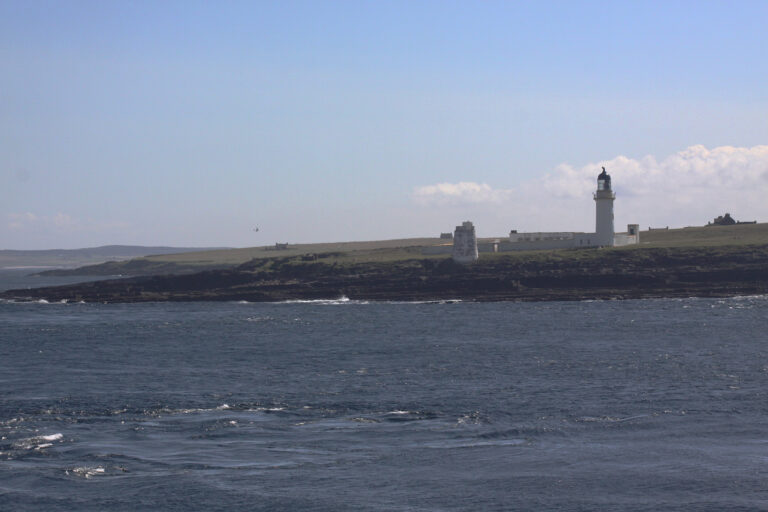
The lighthouse is a white cylindrical tower 22 metres high, with a single gallery and a lantern topped by a black cupola. Beside the tower stand the keepers’ cottages and other buildings, all enclosed within a walled compound that also contains a sundial. A house for the principal keeper was added later. The light stands 35 metres above sea level and can be seen for 18 nautical miles. It shows a single white flash every twenty seconds.
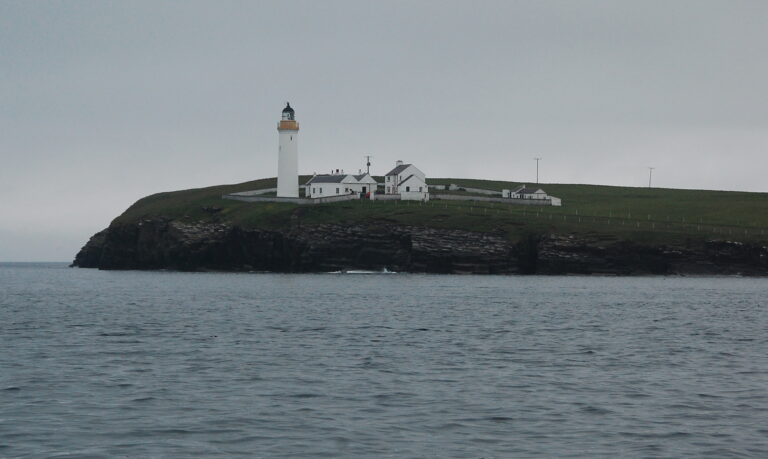
In 1913 a foghorn was installed at the station, and it remained in use until 1987. In 1991 the light was automated, and the keepers’ houses were sold and turned into holiday accommodation. In 2017 the houses of the principal keeper and the first and second assistant keepers were offered for sale together for £300,000. The whole station, including the tower, cottages, outhouses and sundial, is protected as a Category B listed building. The light itself is still maintained by the Northern Lighthouse Board.
Scapa Flow
The lighthouse overlooks one of the most historically important stretches of water in Britain. Scapa Flow was the main base of the Royal Navy’s Grand Fleet in the First World War and an important naval anchorage again in the Second. The Sound of Hoxa, which Cantick Head guards, was one of the main entrances to the Flow, and it was heavily defended with booms, nets and gun batteries. In 1919 the German High Seas Fleet, interned in Scapa Flow after the armistice, was scuttled by its own crews, and several of the wrecks still lie on the seabed, making the Flow one of the best-known wreck-diving sites in the world.
South Walls

South Walls lies just south of Hoy and is joined to it by a narrow causeway called the Ayre, which carries the road to the village of Longhope, the Martello tower at Hackness and on to the lighthouse. The island is low and green, with farmland and small settlements. It is closely linked with the Longhope lifeboat, whose crew was lost with all eight men in a storm in the Pentland Firth in 1969, a tragedy still remembered in the community today.
Visiting
Hoy is reached by car ferry from Houton on Orkney Mainland to Lyness, and from there a road runs south to South Walls and out along Cantick Head to the lighthouse. The lighthouse is a working aid to navigation and is not open inside, but the headland gives wide views across the Pentland Firth to Caithness and the island of Stroma, and back across Scapa Flow. The waters are known for their fierce tides, and seabirds, seals and porpoises are often seen offshore.
About island lighthouses
All lighthouses →Lighthouses have guided shipping around Britain and Ireland for more than two centuries, and many of the most remarkable stand on islands, as close as they can get to the rocks and reefs they warn of. Here you will find every lighthouse on the islands we cover, from the Stevenson towers of the Hebrides and…
