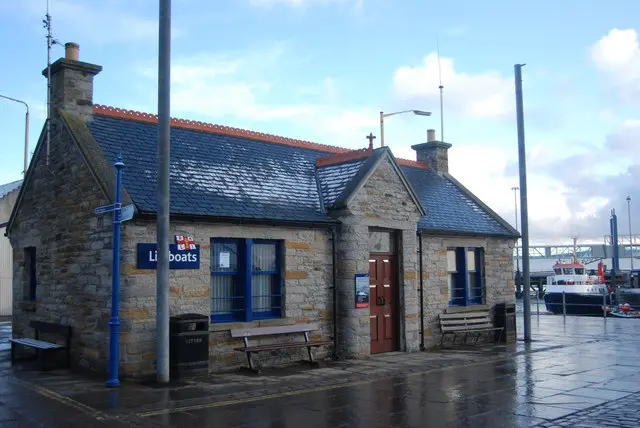
Stromness Lifeboat Station
Stromness Lifeboat Station stands in the harbour of Stromness, the second largest town on Mainland, Orkney. Founded in 1867, it is one of the oldest lifeboat stations in the north of Scotland, and its all-weather lifeboat covers the western approaches to Orkney, Hoy Sound, Scapa Flow and the dangerous waters of the Pentland Firth.
Founding the station
On 1 January 1866 the ship Albion was wrecked on Graemsay, just off Stromness. Ninety people survived, but eleven died, among them a man from Graemsay who tried to help. The disaster led to a request to the RNLI, and in August 1867 the committee agreed to open a station at Stromness, then the most northerly in the RNLI’s network.
A boathouse was built at the Ness for just under £145, and a 33-foot self-righting lifeboat, powered by ten oars and sails, was delivered that August, carried north free of charge by a shipping company. She was paid for by the Bradford mill owner and philanthropist Titus Salt and named Saltaire after his model village in Yorkshire.
Launching from the Ness proved difficult: during one practice in a gale it took more than an hour to get the boat afloat. In 1891 a larger 42-foot lifeboat, Good Shepherd, was placed in the harbour instead, and a new boathouse with a slipway was completed there in 1902. In December 1907 the Good Shepherd rescued six of the ten crew of the Hull trawler Shakespeare, aground near Breckness, and Coxswain Robert Greig received the RNLI Silver Medal.
Into the motor age
Stromness was at the forefront of a new era. In 1909 it received the John A. Hay, one of the first four purpose-built motor lifeboats ordered by the RNLI, with a 30-horsepower petrol engine. She sailed the 768 miles from London to Stromness in fifteen days, arriving on 30 April 1909.
On 1 January 1922 the Grimsby trawler Fresia foundered off Costa Head. The open lifeboat made a bitter nine-hour, 50-mile journey to reach her. Nine of the trawler’s crew died, but two were rescued from a makeshift raft, and Coxswain William Johnston received the Bronze Medal.
HMS Hampshire
The waters off Stromness also saw one of the great tragedies of the First World War. On 5 June 1916 the cruiser HMS Hampshire struck a mine off Marwick Head, 12 miles to the north, and sank with the loss of 737 lives, including Field Marshal Lord Kitchener. Only twelve men survived. The Stromness lifeboat was never called, and whether it could have reached the scene in time in such conditions is still debated.
The station today
A new boathouse and slipway were completed in 1926, and later lifeboats grew too large for the slipway and were kept afloat in the harbour. Since 1998 the station has operated the Severn-class lifeboat Violet, Dorothy and Kathleen, one of the RNLI’s largest all-weather boats, capable of long journeys in heavy seas.
Visiting
Stromness is a historic harbour town of stone houses and narrow lanes, where the ferry from Scrabster arrives past the cliffs of Hoy. The lifeboat lies in the harbour, and the town’s museum tells more of the history of Orkney’s seafarers, from Hudson’s Bay Company men to whalers.
About island lifeboat stations
All lifeboat stations →On islands, the lifeboat is often the only help that can reach someone in trouble at sea, and island lifeboat crews cover some of the most exposed waters around Britain and Ireland. Here you will find the lifeboat stations on the islands we cover, with their history and the boats they launch.


