
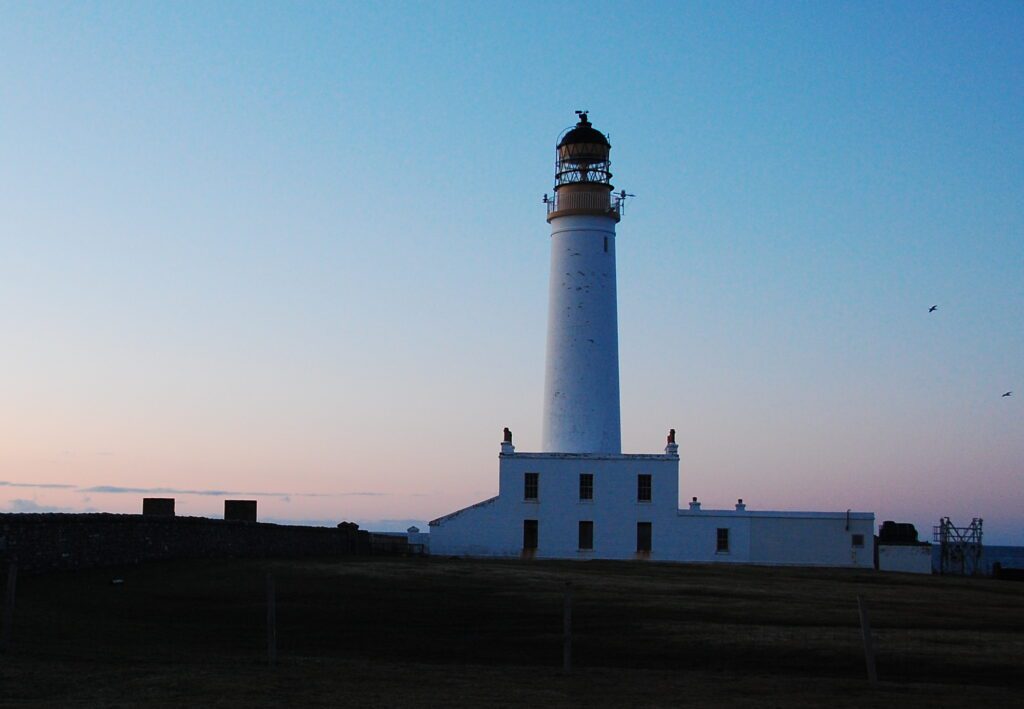
Auskerry Lighthouse
Auskerry Lighthouse stands on Auskerry, a small, flat island of red sandstone in eastern Orkney, about three miles south of Stronsay. The island’s name comes from the Old Norse Austrsker, meaning ‘east skerry’, and its light marks the northern entrance to the Stronsay Firth, guiding vessels moving between the North Sea and the sheltered waters among the northern Orkney islands.
History
The lighthouse was built in 1866 by the engineers David and Thomas Stevenson, members of the family who designed most of Scotland’s lighthouses for the Northern Lighthouse Board. It is a white tower with two attached flats, which once housed the keepers who tended the light and lived on the island with their families.

The waters around Auskerry are dangerous, and the island has seen its share of shipwrecks. In 1926 the Hastings County, a Norwegian cargo ship 116 metres long, ran ashore on the north-west of the island in thick fog. The vessel broke in half, and its wreckage is still spread over a wide area, with the ship’s engine lying on the beach.
The lighthouse was automated in the 1960s, and its keepers were withdrawn. The light is still operated by the Northern Lighthouse Board and monitored remotely. Of the two flats attached to the tower, the lower one is used all year as a store and the upper one mainly in summer.
Island life
Auskerry’s history goes back much further than the lighthouse. A standing stone and the remains of a medieval chapel show that people lived on the island centuries ago, and in more recent times it was a popular place for hunting seals.
After the lighthouse was automated, the island was uninhabited for a time. Since then, for nearly fifty years, it has been home to a single family, who keep a flock of rare North Ronaldsay sheep, a native Orkney breed that is well suited to life on small, windswept islands. Life on Auskerry is simple and self-sufficient. Three small wind turbines and four solar panels provide most of the island’s power. The family’s house began as a single-roomed stone bothy and, after a series of renovations, is now a modern four-bedroom home, though the toilet is still outdoors. Mail arrives from Stronsay once a month by fishing boat.
Wildlife
Auskerry is a place of international importance for seabirds. It is a Special Protection Area because of its breeding colonies of Arctic terns and European storm petrels: about 4.2 per cent of the storm petrels breeding in Great Britain nest on this one small island, hidden in crevices in walls and among stones and coming ashore only at night. BirdLife International has also named Auskerry an Important Bird Area for its breeding seabirds. Grey and common seals are often seen around the shore, and the island lies on the route of many migrant birds in spring and autumn.
Visiting
There is no public ferry to Auskerry, and the island is privately inhabited, so visits need to be arranged in advance, usually by chartered boat from Stronsay. Visitors should take great care not to disturb the nesting birds, especially the terns, which defend their nests fiercely, and the storm petrels, whose nesting sites are easily damaged. The lighthouse is a working aid to navigation and is not open to the public. It can also be seen from the sea, and from the south coast of Stronsay on a clear day.
About island lighthouses
All lighthouses →Lighthouses have guided shipping around Britain and Ireland for more than two centuries, and many of the most remarkable stand on islands, as close as they can get to the rocks and reefs they warn of. Here you will find every lighthouse on the islands we cover, from the Stevenson towers of the Hebrides and…
