

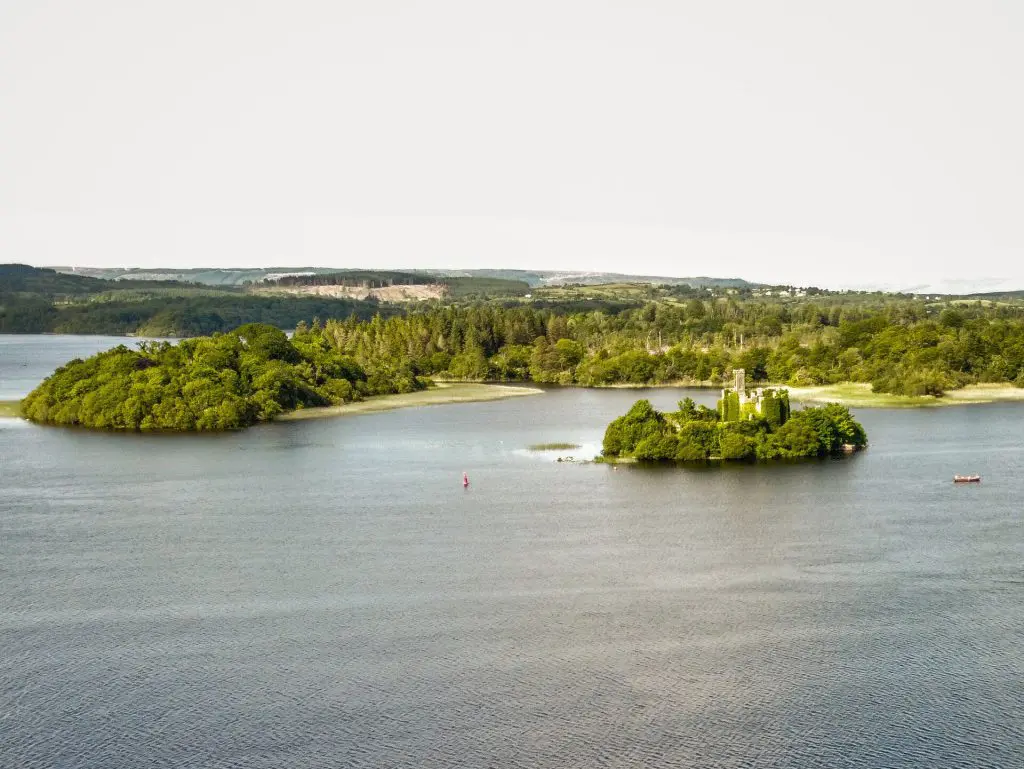
Castle Island, Lough Key
Island Passport
Collect Castle Island, Lough Key
Be the first to collect it
Castle Island is a tiny island of just 0.6 acres in the south-eastern corner of Lough Key, County Roscommon, home to McDermott’s Castle, a protected national monument whose crenellated tower has watched over the lough for the better part of eight centuries.
History
The site has been fortified since at least the 12th century, when it served as the stronghold of the Mac Diarmada dynasty, rulers of Magh Luirg, the medieval kingdom covering much of north-east Connacht from the 10th to the 16th centuries.

The island’s early history was marked by genuine catastrophe: the Annals of Loch Cé record that in 1184 a lightning strike set fire to the “very magnificent, kingly residence” on the rock, killing well over a hundred people sheltering there, including members of the Mac Diarmada family and allied chieftains, with only a handful escaping alive, a disaster so severe that almost everyone present who was not burned to death drowned attempting to flee the blaze. The castle was later rebuilt, only to come under siege during Richard Mór de Burgh’s conquest of Connacht in 1235, an assault that combined a catapult mounted on a raft with fire ships, ultimately forcing Cormac MacDermott, King of Moylurg, to surrender the stronghold.

Castle Island also features in one of medieval Ireland’s more curious literary traditions: a 15th-century poem tells of the Hag of Lough Key, who imposed herself on Cormac MacDermott’s hospitality for a full year during his reign in the 1220s and 30s, an episode later used to justify a supposed hereditary obligation of perpetual hospitality laid upon the MacDermott family. The clan finally lost control of the island in 1586, an event lamented by the poet Eochaidh Ó hÉoghusa, who wrote movingly of the castle’s subsequent emptiness after centuries as a seat of Gaelic power.
By the early 19th century, the castle had passed into the hands of the King-Harman family of the nearby Rockingham estate, who incorporated its ruins into the wider romantic landscape of their demesne, adding much of the present crenellated stonework as an ornamental folly overlooking the lough. Today Castle Island remains one of the most photographed features of Lough Key Forest Park, its ivy-softened tower rising directly from the water and forming an evocative centrepiece to boat trips and lakeside walks exploring this stretch of County Roscommon.
Wildlife
29 species recorded on the island
Highlights


All wildlife
Loading all 29 species…
Nothing on the list is usually seen this month.
Recordings from Wikimedia Commons, under Creative Commons licences; hover a Listen button for the recordist. Sightings are records shared with GBIF since 2000.

