


Castle Bryher
Castle Bryher is one of the Norrard Rocks off Bryher in the Isles of Scilly, a craggy pinnacle of granite rising to 26 metres. Its name, “Bryher’s castle”, comes from its fortress-like shape.
Landscape
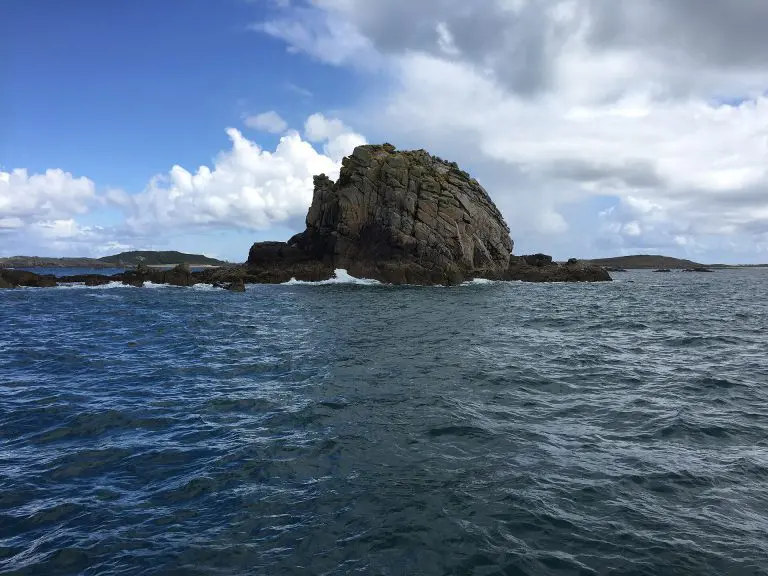
The rock covers only about an acre but stands tall and steep, a landmark from the west coast of Bryher. The Norrard, or Northern, Rocks are a group of seven small islands west of Bryher and Samson: Gweal, Mincarlo, Scilly Rock, Maiden Bower, Castle Bryher, Illiswilgig and Seal Rock. Exposed to every westerly gale, they are mostly bare granite with a little salt-burnt turf.
Wildlife
Castle Bryher, Scilly Rock, Mincarlo and Illiswilgig hold small colonies of European storm petrels, a species that breeds in England only in the Isles of Scilly. The Norrard Rocks have been a Site of Special Scientific Interest since 1971 for their seabird colonies and are managed by the Isles of Scilly Wildlife Trust. They are closed to landing to protect the nesting birds.
Visiting
There is no landing on the Norrard Rocks, but they are well seen from Bryher’s west coast around Hell Bay, and seabird trips from St Mary’s and Bryher circle them in summer. You can collect Castle Bryher as a sighting in your Island Passport.
Wildlife and area

The rocks hold puffins, razorbills, shags, cormorants and storm petrels, and grey seals haul out on the ledges. Nearby islands include Scilly Rock, Maiden Bower and Illiswilgig.
Tides
Now
—
Next high water
—
Next low water
—
Heights in metres relative to mean sea level; times are UK time. Not for navigation. Tide model: Open-Meteo (CC BY 4.0).
Wildlife
6 species recorded on the island
Highlights


All wildlife
Loading all 6 species…
Nothing on the list is usually seen this month.
Recordings from Wikimedia Commons, under Creative Commons licences; hover a Listen button for the recordist. Sightings are records shared with GBIF since 2000.
Watching wildlife responsibly. Keep your distance from seals, seabird colonies and cetaceans, stay quiet, and never feed or chase wildlife. See the WiSe Scheme guidance for watching marine wildlife.


